

T
Sunday, October 17, 2021


His Own Franciscan Order Was Torn From His Hands

Once, when asked by one of the friars why he had abandoned his charge of the friars and entrusted them into the hands of others as they they did not belong to him at all, he replied, "My son, I love the brethren to the utmost of my power, but if they would follow in my footsteps I should love them still more, and would not make myself a stranger to them. For some of the superiors pull them in another direction, holding up to them as patterns the men of long ago, and disregarding my warnings. But what they are doing and the way in which they are now acting will appear more clearly in the end."
And shortly afterwards, when he was burdened with severe illness, he raised himself in bed, and cried out in vehemence of spirit, "Who are these who have torn my Order and my friars from out of my hands?"...
Saint Francis of Assisi
Mirror of Perfection - 41
T

Fonte Colombo Sanctuario
At 5.5 km from Rieti, it is the place where, according to tradition, San Francesco (St. Francis), during a stay of meditation lasting for forty days in 1223, received confirmation of the Franciscan Order by Jesus, which he dictated to Brother Leone.
Francis used to exhort the friars fervently to be faithful to the Rule, saying that he had dictated everything as it was revealed to him by God and that nothing he had prescribed came from himself. This was proved by God's own testimony only a short time afterwards when Francis received the stigmata of our Lord Jesus Christ. This was the seal of Christ, the supreme High Priest, which he gave the Rule and its author his divine approval...
Saint Francis of Assisi
Bonaventure, Major Life
CHAPTER IV
Saint Francis of Assisi
Bonaventure, Major Life
CHAPTER IV
T
Friday, October 15, 2021
O God, My Flesh Faints For You (Psalm 63)

Once when Brother John was staying in the Place of Mogliano of the Custody of Fermo in the Province of the Marches...when he had proceeded as far as the Preface of the Blessed Virgin, the supernatural illumination and sweet consolation of God's love increased so much within him that when he reached the Qui pridie he could hardly endure such overwhelming sweetness. Finally, when he came to the Consecration itself and began to pronounce the words of the Consecration over the Host, he kept repeating the first of the formula - Hoc est - Hoc est - very often, and he was unable to go any further. And the reason why he could not go on was that e felt and saw the presence of Christ and of a throng of angels and saints, so that he almost fainted because of their grandeur which he felt in his soul.
St. Francis of Assisi
Little Flowers of St. Francis - 53
T
Thursday, October 14, 2021
Spiritual Accomplishments Are Worthless Vices

Fra Chris Dickson, F.L.A.
Servant General of the Franciscan Lay Apostolate
"Spiritual accomplishments are not only worthless but can actually become vices." ~ Saint John of the Cross (Dark Night of the Soul)
T
Let Humanity Kneel In Fear

Let humanity kneel in fear, let the whole universe tremble, and let heaven rejoice when Christ the Son of the Living God is on the altar in the hands of the priest.
Saint Francis of Assisi
Letter to the Whole Order
T
Receiving The Food Which Is God Himsel

One day it was raining heavily, and he was riding because of his infirmity and pressing need. And although he was already drenched to the skin, he dismounted from the horse when he wished to say the Hours, and said the Office standing in the road with the rain pouring down on him, as though he had been in a church or cell. And he said to his companion, 'If the body likes to take food in peace and ease, although it becomes food for worms, how much greater should be the soul's reverence and devotion when it receives the food which is God Himself.'
Saint Francis of Assisi
Mirror of Perfection - 94
T
Wednesday, October 13, 2021
The Servant Of God Must Show Joy

If Saint Francis saw any of his companions with a sad or downcast countenance, he reproved him, saying: "If thou art grieving over thy sins, my brother, why dost thou show thy sorrow exteriorly? Let this sadness be between thee and God, and pray to him that through his mercy he may spare thee and restore to thy soul the joy of salvation, which thou hast lost through thy sins. But before me and others, show thyself always joyful, for it does not become the servant of God to manifest sadness exteriorly, nor to have a troubled countenance."
St. Francis of Assisi
Miscellaneous Writings
T
Footprints In The Fire

To say that the road the soul travels to God is through the sea (the Prophet Baruch) and that His footsteps are in the many waters and so unknowable is to say that the way to God is as hidden to the inner senses as would be footprints on the water of the outer senses. The traces God leaves on the souls He wants to bring to Himself are unrecognizable. Secret.
St. John of the Cross
Dark Night of the Soul
Night of the Spirit
St. John of the Cross
Dark Night of the Soul
Night of the Spirit
T
Tuesday, October 12, 2021
The Cross Is The "Ladder" Of Monks

The grace of God and the virtues which flow therefrom are a way and a ladder that leads to heaven; but vices and sins are a ladder and a way that leads to the depths of hell. Vices and sins are a venomous and a mortal poison, but virtues and good works are a salutory medicine. One grace leads to another; and one vice leads to another. Grace asks not to be praised, and vice cannot endure to be despised. The mind reposes tranquility in humility, of whom patience is daughter. Holy purity of heart sees God, and true devotion enjoys him.
Saint Francis of Assisi
Little Flowers of St. Francis
Part Four
Chapter 1
Saint Francis of Assisi
Little Flowers of St. Francis
Part Four
Chapter 1
T
For The Love Of God

Among other words used in ordinary conversation, Francis could never hear 'FOR THE LOVE OF GOD' without a kind of transformation within himself. For immediately upon hearing 'FOR THE LOVE OF GOD,' he would become excited, stirred, and inflamed, as though an inner chord of his heart had been plucked by the plectrum of the outward voice of the speaker.
Saint Francis of Assisi
Celano, Second Life - 196
T
Our Body Ia Our Cell

Wherever we are, wherever we go, we bring our cell with us. Our brother body is our Cell and our soul is the hermit living in that cell in order to pray to God and meditate. If our soul does not live in peace and solitude within its cell, of what avail is it to live in a man-made cell?
Saint Francis of Assisi
Legend of Perugia - 80
T
Monday, October 11, 2021
Sunday, October 10, 2021
Wear His Crown Of Thorns As A Crown Of Glory!

by
Fra Chris Dickson, F.L.A.
of the Portiuncula Hermitage
Fra Chris Dickson, F.L.A.
of the Portiuncula Hermitage
I was in an area of complete and utter darkness. Then a mist appeared, through which two hands appeared that were handing me a crown of thorns.
I took the crown of thorns from the outstretched hands and placed it upon my head. As the crown was being seated upon my head, I prematurely winced, fully expecting searing pain from those thorns to shoot through my head and throughout my entire body.
But instead of pain, a warm and wonderful feeling of joy and peace settled over me. I was being bathed in God’s love.
Simultaneously with the crown of thorns being placed upon my head, a vision appeared before me of a glass mirror “unfurling” like a window shade, even though it was glass.
Jesus then appeared in the glass before me.
I was immediately filled with shame because Jesus had caught me wearing his crown, and I immediately pulled it from my head.
As I did, Jesus disappeared.
I then placed the crown back onto my head.
As I did, the glass unfurled before me, and again Jesus was standing before me.
At that moment, the realization hit me that I was looking into a mirror and seeing my own reflection, and that reflection was my Savior and my Lord! And me! One and the same!
This vision greatly troubled me. After all, who did I think I was, anyway? Was I so vain as to think myself equal to Jesus? God forbid! The vision continued to frighten me long afterwards, fearing that my attitude was obviously not right with God…that is, until I heard these words:
“Do not be afraid to put on my crown of thorns.
It is My crown of glory!
Wear it as I did.
I will bear the pain so that you have none.
Then, and only then, will you see Me in glory.
Then we shall meet face to face.
You in me, and I in you.
People will see me in your image.
Give yourselves to Me fully,
And I will come to you in glory…”
T
Saturday, October 09, 2021
There Is No Better Sermon Than The Practice Of Virtues

"The worth of knowledge is proportionate to the actions it produces; there is no better sermon than the practice of the virtues."
Saint Francis of Assisi
Legend of Perugia - 74
T
Your Cell Will Teach You Everything

In Scetis, a brother went to see Abba Moses and begged him for a word. The old man said, "Go and sit in your cell and your cell will teach you everything."
Saying From the Desert Fathers
T
Friday, October 08, 2021
Blessed Jacapone da Todi (1230 A.D. to December 1306 A.D.)
T
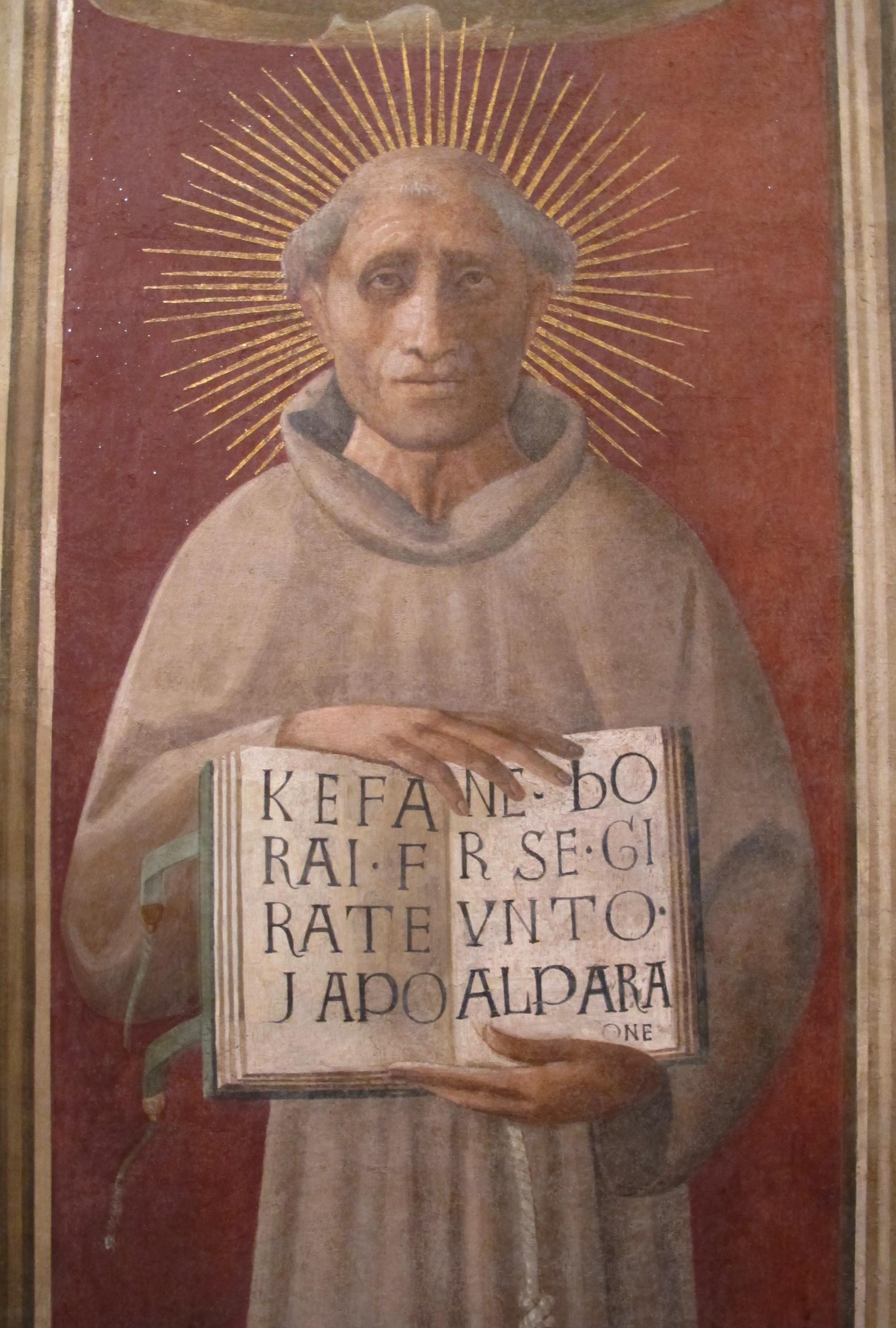
Jacopone ("Crazy Jim") da Todi was admitted into the Franciscan Order in 1278 A.D. He chose to live as a lay brother. By this time, two broad factions had arisen in the Franciscan Order, one with a more lenient, less mystical attitude and one being more severe, preaching absolute poverty and penitence (known as the "Spirituals" or Fraticelli). Jacopone was connected with the latter group.
The Latin poem Stabat Mater Dolorosa is generally attributed to Jacopone, although this has been disputed. It is a fine example of religious lyric in the Franciscan tradition (SEE YOUTUBE BELOW). It was inserted into the Roman Missal and Breviary in 1727 for the Feast of the Seven Sorrows of the Blessed Virgin Mary, celebrated on the Friday before Good Friday. Following changes by Pope Pius XII, it now appears on the Feast of Our Lady's Sorrows celebrated on 15 September. Many composers have set it to music.
The Latin poem Stabat Mater Dolorosa is generally attributed to Jacopone, although this has been disputed. It is a fine example of religious lyric in the Franciscan tradition (SEE YOUTUBE BELOW). It was inserted into the Roman Missal and Breviary in 1727 for the Feast of the Seven Sorrows of the Blessed Virgin Mary, celebrated on the Friday before Good Friday. Following changes by Pope Pius XII, it now appears on the Feast of Our Lady's Sorrows celebrated on 15 September. Many composers have set it to music.
Jacopone was steadfast in condemning corruption, especially through his satirical Italian poems. Jacopone would not recant his position on the requirement of ascetic poverty, believing that the mainstream Church had become corrupt and that its ministers were not interested in the welfare of the poor. (Much like today's ultra-modern Church's approach to Environmentalism rather than seeing the need to preach the Gospel and to save lost souls).
T
God Is Still Homeless

We build a church to God and He is still homeless because we have built it for ourselves, and our humble God sits on the step outside begging.
Brother Juniper
God's Holy Fool
T
Can You Catch The Wind?

A brother came to Abba Poemen and said, "Abba, a variety of thoughts are coming into my mind and I am in danger!" The old man took him out into the air and said, "Open your robe and take hold of the wind." The young brother answered, "No, I cannot do it." The old man said, "If you cannot do it, neither can you prevent those thoughts from entering into your mind. What you should do is stand firm against them."
Sayings of the Desert Fathers
T
The Two Small Coins Of St. Francis

Body / Soul
Christ's Poor One, Francis, possessed nothing but two small coins (Mark 12:42) which he could dispose of with largesse and charity: his body and his soul. But those two mites he offered to God continually, for the love of Christ; he seemed always to be immolating his body with rigor and fasting and his soul with the flame of desire: his body, a holocaust outside in the court of the temple; his soul, incense offering in the inner temple.
Saint Francis of Assisi
Saint Francis of Assisi
St. Bonaventure, Major Life
Chapter 9
T
Who Or What Is The Leper In Your Life?

Among all the unhappy spectacles of the world Francis naturally abhorred lepers; but one day he met a leper while he was riding near Assisi. Though the leper caused him great disgust and horror, nevertheless, lest like the transgressor of a commandment he should break his given word, he got off his horse and prepared to kiss the leper. But when the leper put out his hand as though to receive something, he received money along with the kiss. And immediately, mounting his horse, Francis looked here and there about him; but though the plain lay open and clear on all sides, and there were no obstacles about, he could not see the leper anywhere.
Saint Francis of Assisi
Celano - Second Life
Chapter V
T
Thursday, October 07, 2021

Monday, October 04, 2021
The Catholic Church vs. Liberation Theology

by Chris Dickson, F.L.A.
I am appalled by the naivete of our Church being duped into anti-Christian communism. Liberation theology is a threat to free society by its undermining of the Church and its Magisterium through attempting to redefine moral issues (changing the Gospel to support theology opposed to shaping theology as a result of the Gospel.)
Ignorance is not bliss and unless we familiarize ourselves with the dangers, then future generations will demand answers as to why we threw away our freedom in lieu of communism.
To quote Gustavo Gutierrez (the "father" of liberation theology,) "There is no evil in being subversive, struggling against the capitalist system...Liberation leads to reinterpreting the Gospel...As I have witnessed the power of Marxism to provide motivation for a life of service where none existed before, I have come to a new appreciation of this part of my own history. I cannot settle for any story of America that fails to give a central place to this vision."
Again, Roger Garaudy (one of France's foremost Marxist intellectuals) wrote, "Socialism is a traditional stage in the passage from capitalism to communism." Also, "When the established order involves such injustice that millions of men are exploited, oppressed, mutilated, and humiliated by this order, a revolution, even armed revolution, can be less costly and in the long run less 'violent' than this established disorder, which has become pure violence. Of this, incidentally, many Christians are today becoming conscious, including, for example, even priests and bishops in Latin America."
Charles E. Curran, no longer permitted by the Church to teach moral theology at Catholic universities, has stated,"Questions arise in the light of both the importance and the limitations of Scriptures. In the light of the most striking development has been the emergence of dissent within the Roman Catholic theological community from the teachings of the hierarchical magisterium on specific moral issues."
One cannot help but feel an air of approval when local archdiocesan newspapers print articles written by these people. Already we have seen a swing by our priests and educators away from the Church's doctrine of "norma normans non normata"(the Scriptures being the norm above all other norms by which all norms are taken) and are thus shown to question the Scripture's relevance in our daily lives.
Perhaps we need to seek the definition of a couple terms which seem to have taken on good and bad connotations in complete reversal of their intended meanings:
First of all, the term orthodoxy means "right praise," or consistency with the faith of the Church as embodied in Sacred Scripture, the Fathers, official teachings and the liturgy.
Libertaion theology, on the other hand, is defined as a new type of theology which emphasizes the motif of liberation in both Old and New Testaments and which reinterprets all doctrines in terms of that motif. Forms of liberation theology include Latin American, black and feminist.
Jesus "liberated" all of us from the bonds of oppression. Rather than reinterpreting the Gospel, perhaps we would be better served to "live it." This idea may not be popular with some in the Church today, but by returning to the basics of our faith, we will be truly liberated through the instruction of Sacred Scriptures if only we would accept Jesus as the catalyst of our lives.
Ignorance is not bliss and unless we familiarize ourselves with the dangers, then future generations will demand answers as to why we threw away our freedom in lieu of communism.
To quote Gustavo Gutierrez (the "father" of liberation theology,) "There is no evil in being subversive, struggling against the capitalist system...Liberation leads to reinterpreting the Gospel...As I have witnessed the power of Marxism to provide motivation for a life of service where none existed before, I have come to a new appreciation of this part of my own history. I cannot settle for any story of America that fails to give a central place to this vision."
Again, Roger Garaudy (one of France's foremost Marxist intellectuals) wrote, "Socialism is a traditional stage in the passage from capitalism to communism." Also, "When the established order involves such injustice that millions of men are exploited, oppressed, mutilated, and humiliated by this order, a revolution, even armed revolution, can be less costly and in the long run less 'violent' than this established disorder, which has become pure violence. Of this, incidentally, many Christians are today becoming conscious, including, for example, even priests and bishops in Latin America."
Charles E. Curran, no longer permitted by the Church to teach moral theology at Catholic universities, has stated,"Questions arise in the light of both the importance and the limitations of Scriptures. In the light of the most striking development has been the emergence of dissent within the Roman Catholic theological community from the teachings of the hierarchical magisterium on specific moral issues."
One cannot help but feel an air of approval when local archdiocesan newspapers print articles written by these people. Already we have seen a swing by our priests and educators away from the Church's doctrine of "norma normans non normata"(the Scriptures being the norm above all other norms by which all norms are taken) and are thus shown to question the Scripture's relevance in our daily lives.
Perhaps we need to seek the definition of a couple terms which seem to have taken on good and bad connotations in complete reversal of their intended meanings:
First of all, the term orthodoxy means "right praise," or consistency with the faith of the Church as embodied in Sacred Scripture, the Fathers, official teachings and the liturgy.
Libertaion theology, on the other hand, is defined as a new type of theology which emphasizes the motif of liberation in both Old and New Testaments and which reinterprets all doctrines in terms of that motif. Forms of liberation theology include Latin American, black and feminist.
Jesus "liberated" all of us from the bonds of oppression. Rather than reinterpreting the Gospel, perhaps we would be better served to "live it." This idea may not be popular with some in the Church today, but by returning to the basics of our faith, we will be truly liberated through the instruction of Sacred Scriptures if only we would accept Jesus as the catalyst of our lives.
T
A Time To Become Holy

http://theyoke.org/a-time-to-become-holy.html
"To grow in holiness, we must first return to regularly receiving the Sacraments and the first step to returning to the Sacraments is an examination of conscience; the Sacrament of Reconciliation."

"Be Holy for I Am Holy."
We are in the middle of a crisis of faith...

Certainly not! We see in Psalm 51 how we are to become holy through a broken and contrite heart. So how do we obtain a broken and contrite heart? St. Francis of Assisi showed great insight here by telling his followers that he preferred absolutely nothing to preaching repentance and penance, which was considered folly at that time because the fear and love of the Lord had died out in the world. The same can be said of our modern, Post-Christian world as well.
So how do we grow in holiness? We grow in holiness by accepting the Father's love and seeking His forgiveness. The closer we grow with the Father, the more we become like Jesus, and like Jesus, our hearts must first truly burn with a desire to grow in holiness. This is impossible without first surrendering our lives to God just as Jesus surrendered his to the Father.

We should frequent the Sacrament of Reconciliation...Advent is a time to reflect on our status as prodigal sons and daughters of the Most High. Just as the prodigal son, we too must eventually come to our senses. Today's modernist society too often justifies sin or else denies it completely. Rampant drug and alcohol abuse, disrespect for adults and for one another, malicious gossip, cheating on our income taxes, refusing to forgive others, sexual depravity and Abortion have become society's new norm. We are in the middle of a crisis of faith in Jesus Christ. It's very easy to allow ourselves to become discouraged by all the negativity, but we must realize that the people are hungry. The people are hungry for the truth. They desire more out of life than simply wandering aimlessly about, day in and day out, in total hopelessness. They want to find joy. But there can be no joy separate from holiness!

Don't expect holiness to happen overnight...To grow in holiness, we must first return to regularly receiving the Sacraments and the first step to returning to the Sacraments is an examination of conscience; the Sacrament of Reconciliation. Just as the prodigal son returned to his father and begged forgiveness for his sins, we must also return to the Father and beg his forgiveness for sinning against Him. St. Francis of Assisi tells us that we should frequent the Sacrament of Reconciliation at least once a month. Why is that so important? Well, it helps us see our sins and seek God's mercy by experiencing His tender love for us. We can never hope to grow in holiness without the Sacrament of Reconciliation for if we are truly going to get serious about coming to our senses and receiving the Father’s love, then we will first go to Him with broken and contrite hearts and confess our sins to Him, not just during Advent, but at least once a month. Why is that? Because it helps us to see our sins, to seek God’s mercy, and to experience his tender love for us.

The second step in growing in holiness is by returning to the Eucharist. We must never separate the Eucharist from our daily lives or our daily lives from the Eucharist. Jesus satisfies our hunger for him by giving us his Body and Blood, just as we must satisfy His hunger for the souls of the poor, the marginalized and the oppressed by becoming Eucharistic for the people.
Don't expect holiness to happen overnight. Most of us become overwhelmed and discouraged if we don't see ourselves become holy right away. Remember, the saints were first sinners, some of them great sinners. It took many years for the saints to become holy as they were prone to the same trials and failures that we experience in today's world. The important thing is that we persevere, realizing that the Father loves us unconditionally.

Chris Dickson is the Servant General of the Franciscan Lay Apostolate (F.L.A.) Located at the Portiuncula Franciscan Hermitage and Retreat Center in Jerusalem, Ohio, next to the Immaculate Conception Cemetery. The F.L.A. follows the Medieval Penitential First Rule of the Third Order of St. Francis, dated 1221 A.D., placing themselves under Holy Obedience to the Bishop of Steubenville and Fr. Timothy Davison of the Catholic Churches of Monroe County, Ohio

October 4th, the Feast of St. Francis of Assisi

The larks are friends of daylight and shun the shadows of twilight. But on the eve that St. Francis passed from this world to Christ, just as twilight was descending, the larks rose up to the roof of his cell and began circling it with clamor of wingbeat and song. No one knew if they were singing with joy or sadness, for their voices were filled with joyful tears and sad joy, as if they were orphaned children weeping and singing their father into heaven. The city guards who were keeping watch were filled with wonder and they summoned others to witness the sight.
Celano - Treatise on the Miracles
T
Sunday, October 03, 2021
The Transitus of St. Francis of Assisi (October 3, 1226 A.D.)

Then he (St. Francis) asked the Brothers to read the passage of St. John's Gospel which begins: "Before the paschal feast began" (John 13:1); only a partition of flesh now separated him from his Beloved and he would listen to the beat of his voice in the Gospel phrases. All God's mysteries had been finally accomplished in him and he died quietly, praying and singing the psalm. His holy soul was freed from his body and absorbed in the abyss of eternal glory.
Saint Francis of Assisi
Bonaventure, Minor Life
Chapter VII
Saint Francis of Assisi
Bonaventure, Minor Life
Chapter VII
T
Subscribe to:
Posts (Atom)